 how-to
How to Transfer a Vehicle Title in Nevada
Table of Contents
- Understanding Nevada Vehicle Title Transfer Basics
- Nevada Car Title Transfer Documents You'll Need
- Nevada Vehicle Title Transfer Requirements and Signatures
- How to Complete the Title Assignment Process
- Nevada Vehicle Title Transfer as a Gift
- Nevada Vehicle Title Transfer After Death
- Submitting Your Documents to the Nevada DMV
- Common Mistakes to Avoid During Title Transfer
- Frequently Asked Questions
Last Updated: October 13, 2026
Understanding Nevada Vehicle Title Transfer Basics
A vehicle title transfer in Nevada is the legal process of changing a car's ownership when you buy, sell, inherit, or receive it as a gift.
Most transfers follow the same process: the seller signs the back of the title, the buyer completes an application, and both submit documents to the Nevada DMV.
Nevada Car Title Transfer Documents You'll Need
Original Title and Identification
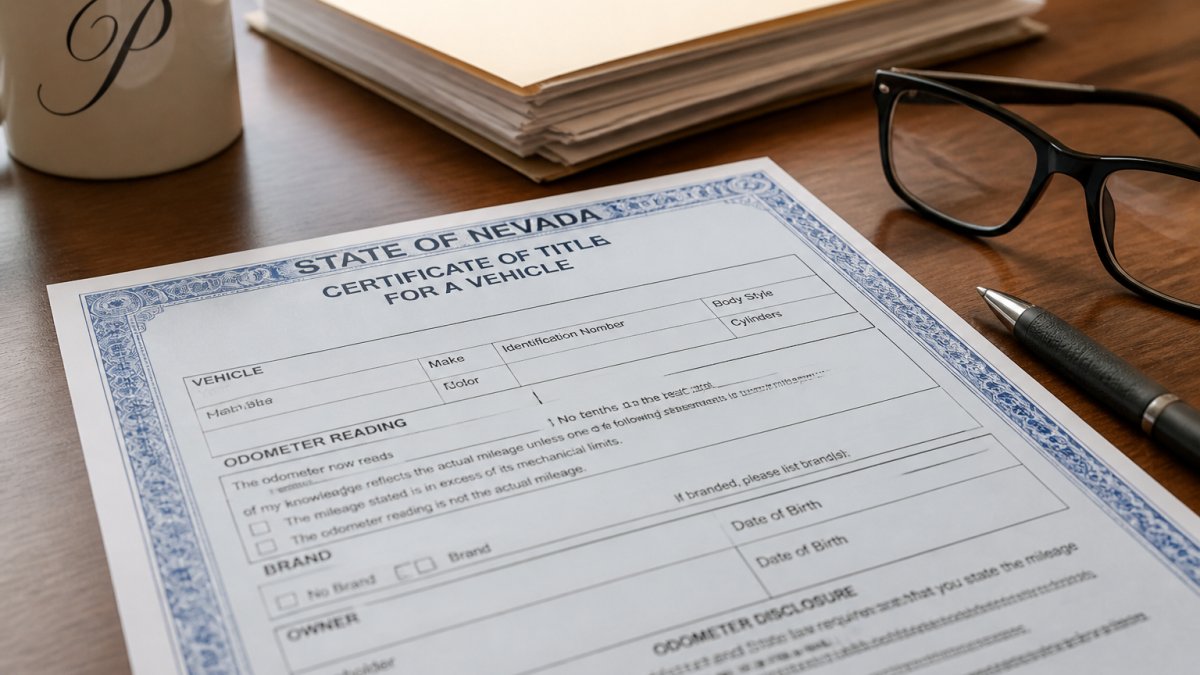
You'll need the original title, the physical certificate issued by the Nevada DMV showing current ownership. If it's lost, stolen, or damaged, get a duplicate first with proof of ownership and identification.
Both parties need valid ID, a driver's license, passport, or state ID. Out-of-state residents can use their home-state ID.
Application for Certificate of Title
The buyer must complete an application for a new title, which collects the VIN, make, model, year, odometer reading, buyer's full legal name and address, and seller's information.
Get the form from the Nevada DMV website or any DMV office. Many people use a document preparation service to ensure it's filled out correctly.
Proof of Ownership and Sale
You need to prove the vehicle changed hands. A bill of sale, showing sale price, vehicle details, and both signatures, is the most common proof.
For a gift, use a gift affidavit instead, stating no money changed hands and explaining the transfer.
Nevada Vehicle Title Transfer Requirements and Signatures
Seller Responsibilities and Signature Requirements
The seller signs the back of the original title in the assignment section. The signature must match the name printed on the front; if you've changed your legal name, bring documents showing the change. The seller must also provide the odometer reading, which Nevada law requires.
Buyer Information and Legal Name Requirements
The buyer must provide their full legal name exactly as it appears on their ID; any mismatch causes delays. If the buyer recently changed their legal name, bring supporting documents, divorce decree, court order, or other official paperwork. The address must be current, since the DMV uses it to send registration documents.
Notarization and Third-Party Interests
Some transfers require notarization, often when a bank or lender holds a lien on the vehicle. A notary is authorized by the state to witness signatures and verify signers' identities.
If you're unsure whether notarization is required, contact the Nevada DMV or a service like Premier Multiservices.
How to Complete the Title Assignment Process
Step-by-Step Assignment Instructions
Step 1: Gather all required documents. Collect the original title, bill of sale, ID for both parties, and the completed application.
Step 3: The buyer completes the application. Fill it out accurately, double-checking all spelling and numbers.
Step 4: Arrange notarization if needed. If a lien is involved or DMV rules require it, get the documents notarized.
Handling Liens and Lien Release
A lien is a legal claim on the vehicle by a lender. If you financed the car, the lender holds a lien until the loan is paid off, and it must be cleared before transferring the title.
Contact your lender to request a lien release, a document showing the loan is paid off, and include it with your title transfer documents.
Nevada Vehicle Title Transfer as a Gift
Transferring a vehicle as a gift follows similar steps to a sale, but no money changes hands. Instead of a bill of sale, complete a gift affidavit stating the vehicle is a gift and explaining the relationship between giver and receiver. Both parties must sign it, and a notary should witness the signatures.
Nevada Vehicle Title Transfer After Death
When someone passes away, their vehicle becomes part of their estate.
The process depends on whether there's a will and whether the estate goes through probate court.
If there's a valid will naming who gets the vehicle, bring a copy of the will and a death certificate to the Nevada DMV. The inheritor completes an application for title transfer.
If there's no will, Nevada intestacy laws determine who inherits.
For complex situations involving estates, wills, or probate, Premier Multiservices can help navigate the paperwork.
Submitting Your Documents to the Nevada DMV
Once the title is assigned and all supporting paperwork is signed, the transfer package goes to the Nevada DMV. How you submit it, in person, by mail, or through a DMV-approved alternative, changes how fast you get a new title.
What Goes in the Submission Package
Before you hand anything over, assemble a complete packet. A missing page is the most common reason a transfer stalls.
- The original, properly assigned certificate of title (signed by the seller in the assignment section on the back)
- A completed Application for Certificate of Title/Registration
- A bill of sale or, for gifts, a gift affidavit
Make photocopies of every page before you submit, so you can reconstruct the packet quickly if the DMV rejects it.
In-Person Submission at a DMV Office
In-person submission is the fastest way to catch problems. A clerk reviews the packet while you wait and tells you on the spot if a signature is missing, a name doesn't match, or a form is outdated.
Practical tips for the counter:
- Book an appointment online. Walk-in wait times at metro offices can run well over an hour, and some services are appointment-only.
- Bring originals, not copies. The DMV needs to see the actual title and identification.
- Bring the seller if you can, so both parties can answer questions or sign a correction on the spot.
If the clerk finds a fixable issue, a missing middle initial, an unsigned odometer block, you can often correct it at the counter and resubmit the same day.
Mail Submission and Processing Timelines
Mail submission works, but it's slower and less forgiving. If something is wrong, you find out weeks later when the packet comes back.
- Send the packet by certified mail with return receipt requested so you have proof of delivery.
- Include a short cover letter listing every enclosed document.
- Never mail the only original of anything you can't replace. If the title is the only original, that's unavoidable, but keep copies of everything else.
Processing timelines vary by workload and office. Mail submissions commonly take several weeks from receipt to a mailed title, while in-person submissions are typically processed faster because the packet is verified at the counter.
Fees and Payment Methods
Title and registration fees in Nevada are set by statute and adjusted periodically, so the exact amount depends on the vehicle, the county, and whether you're also registering.
What you can count on:
- A title fee is charged for issuing the new certificate of title.
- A registration fee applies if you're registering at the same time.
- A county-specific supplemental government services tax may apply based on the vehicle's value and age.
Accepted payment methods at DMV offices typically include cash, personal check, money order, and major debit or credit cards, though cards may carry a convenience fee.
Nevada DMV current fee schedule and payment methods
Registration After the Transfer
In most private-party sales, the buyer registers the vehicle at the same time the title is transferred, so the same visit or mailing covers both applications. If you're transferring the title but not registering yet, for example, the vehicle won't be driven, ask the clerk how to handle the registration portion so you don't trigger a lapse or late fee later.
When the DMV Rejects the Packet
Rejections are common and usually fixable. The DMV returns the packet with a note explaining what's wrong. Typical reasons include:
- Seller's signature doesn't match the printed name on the title
- Buyer's name doesn't match their identification
- Odometer disclosure is missing or inconsistent
Correct the specific issue and resubmit. For a name mismatch, bring supporting documents (marriage certificate, divorce decree, court order). For a missing lien release, request a duplicate release letter from the lender. If the title is damaged or altered, you may need a duplicate title first.
Common Mistakes to Avoid During Title Transfer
Most rejected title transfers trace back to a handful of avoidable errors. Use the checklist below for your situation, then the troubleshooting guide for common problems.
Scenario-by-Scenario Checklist
Use the row that matches your situation. Each row lists what's different from the standard private-party sale.
Private-party sale (buyer and seller, no lien)
- Original title, signed by the seller in the assignment section on the back
- Bill of sale with sale price, date, VIN, and both signatures
- Odometer disclosure completed
Gift transfer
- Original title, signed by the giver in the assignment section
- Gift affidavit signed by both giver and receiver, notarized (this replaces the bill of sale; don't submit both unless the DMV asks)
- Buyer's Application for Certificate of Title/Registration
Inherited vehicle (with a will)
- Original title, if available
- Certified copy of the death certificate
- Copy of the will naming the inheritor, or a court order appointing the personal representative
Inherited vehicle (no will, probate required)
- Certified copy of the death certificate
- Court order or letters of administration identifying who has authority to transfer the vehicle
- Application for Certificate of Title/Registration
Vehicle with an active lien
- Everything in the private-party sale row, plus:
- Lien release or lien satisfaction letter from the lender
- Notarization of the seller's signature, if the lender or DMV requires it
Out-of-state title being brought into Nevada
- The out-of-state title, properly assigned by the seller
- A VIN inspection, which the DMV requires for out-of-state vehicles
- Odometer disclosure
Duplicate or replacement title needed first
- Application for Duplicate Certificate of Title
- Valid ID
- Proof of ownership or lien release, if applicable
Troubleshooting Rejected or Incomplete Transfers
Signature doesn't match the printed name. The most common rejection.
Missing lien release. The DMV won't issue a clean title while a lien is on record.
Wrong form version. The DMV updates forms periodically, and an outdated form will be rejected.
Out-of-state title that doesn't transfer cleanly. Some states' titles lack fields Nevada requires, or the assignment section is already full.
A Note on Timing
Nevada gives buyers a limited window to complete the transfer and registration after a purchase. Missing it can trigger late fees and, in some cases, a citation if the vehicle is driven unregistered. Start the process the day you take possession.
Frequently Asked Questions
What documents do I need to transfer a vehicle title in Nevada?
You'll need the original vehicle title, a completed Application for Certificate of Title (Form CC-1), proof of ownership, a bill of sale, and valid identification. If there's a lien on the vehicle, you'll also need a lien release document from the lender. Out-of-state titles require additional documentation. Having all documents prepared correctly before submission prevents delays and rejection.
How long does it take to transfer a vehicle title in Nevada?
Processing times vary depending on your submission method. In-person submissions at a Nevada DMV office typically receive faster processing than mail submissions. Mail submissions can take several weeks depending on mail delivery times and DMV workload. Contact your local DMV office or check their website for current processing timelines, as these can change seasonally.
Can I transfer a vehicle title as a gift in Nevada?
Yes, you can transfer a vehicle title as a gift in Nevada. The process is similar to a standard title transfer, but you'll indicate 'gift' as the transaction type on the application. Both the donor and recipient must sign the title assignment. Some gift transfers may require additional documentation to establish the relationship or intent of the gift.
What happens if the vehicle owner has passed away?
If the vehicle owner has died, the title transfer process involves the estate or designated beneficiary. You'll need the death certificate, proof of inheritance or estate documentation, and possibly a court order depending on the estate's complexity. The process differs from a standard transfer, so consult with the Nevada DMV or a legal professional to ensure you follow the correct procedures for your specific situation.