 ultimate-guide
Which Documents Are Required to Be Apostilled?
Table of Contents
- What an Apostille Actually Certifies
- Documents Required to Be Apostilled: The Main Categories
- Apostille vs Authentication: How to Tell Which One You Need
- How to Get a Document Apostilled: Step-by-Step
- Apostille Processing Time and What Slows It Down
- When an Apostille Gets Rejected: Common Problems and Fixes
- 1. The notary's commission does not match the issuing state
- 2. The document is a photocopy, not a certified copy
- 3. The notary's commission expired before the signing date
- 4. The document was sent to the wrong authority
- 5. The document needs prior certification that was skipped
- 6. The destination country has requirements the apostille alone does not satisfy
- A pre-submission checklist
- Frequently Asked Questions
Last Updated: September 27, 2026
What an Apostille Actually Certifies
Which documents are required to be apostilled? An apostille authenticates the signature and seal of a public official so a document can be recognized in another country. It does not verify your document's content, only that the official who signed it was legitimate at the time.
The Hague Convention in Plain Terms
The Hague Convention of 5 October 1961 Abolishing the Requirement of Legalisation for Foreign Public Documents created a single, standardized certificate that replaces the older, slower consular legalization chain. Countries that signed the treaty accept each other's apostilles without further review. If your destination country is a treaty member, you need an apostille.
Documents Required to Be Apostilled: The Main Categories
Which documents are required to be apostilled? They fall into four categories: vital records, educational documents, business and corporate filings, and notarized personal documents. Each has its own issuing authority, and knowing which one you're dealing with is the first step in avoiding a rejection.
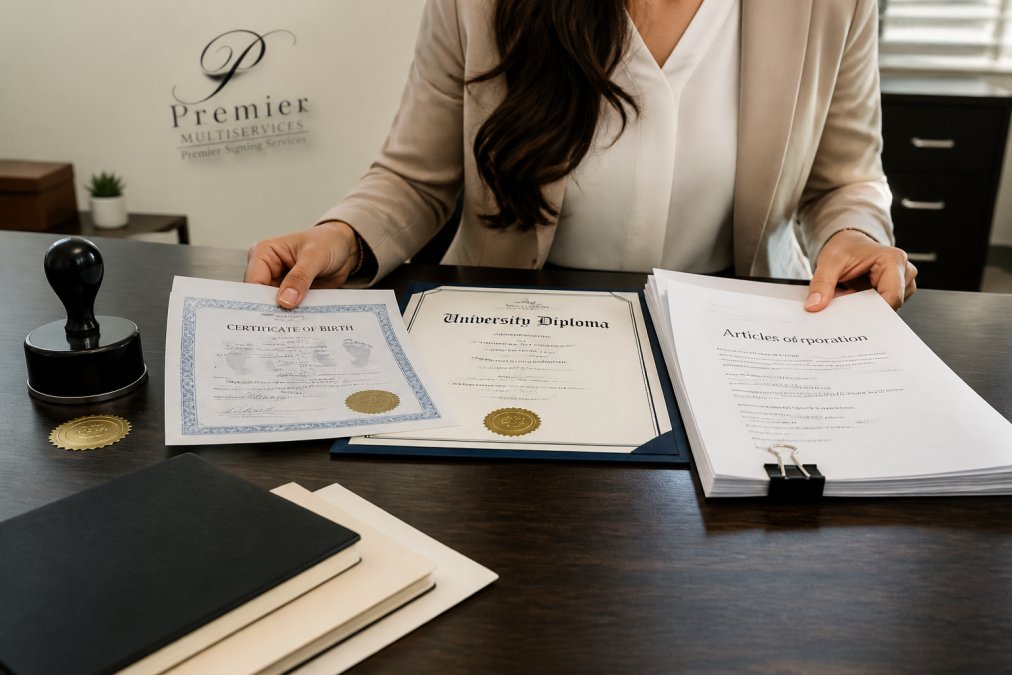
1. Vital Records: Birth, Marriage, and Death Certificates
Vital records, birth, marriage, and death certificates, and sometimes divorce decrees, are the most commonly apostilled documents. They are issued by a state or county registrar, so the apostille must come from the secretary of state in the issuing jurisdiction.
2. Educational Documents: Transcripts and Diplomas
A diploma or transcript must first be notarized, then often verified by the state where the school is located, before the secretary of state will issue the apostille. Some states require the school registrar to sign in front of a notary; others accept a notarized copy.
3. Business and Corporate Documents
Business documents include articles of incorporation, certificates of good standing, operating agreements, and powers of attorney for international transactions. A certificate of incumbency is often required alongside the apostille when opening a foreign bank account.
4. Notarized Documents, Affidavits, and Powers of Attorney
Notarized documents are the broadest category: affidavits, powers of attorney, consent letters for minors traveling abroad, and single-status declarations. The process starts with a notary public who witnesses the signature and applies their seal, then goes to the county clerk (in some states) and the secretary of state.
Apostille vs Authentication: How to Tell Which One You Need
The difference comes down to one question: is the destination country a Hague Convention member? If yes, you need an apostille from the secretary of state. If no, you need authentication through the U.S. Department of State and often the destination country's embassy or consulate.
Here is the quick way to tell them apart:
| Destination | What You Need | Where It Is Issued |
|---|---|---|
| Hague Convention member | Apostille | Secretary of state |
| Non-member country | Authentication | U.S. Dept. of State + embassy |
| Federal document | Apostille or authentication | U.S. Dept. of State |
| State-issued document | Apostille | Secretary of state |
How to Get a Document Apostilled: Step-by-Step
Getting a document apostilled involves four stages: confirm the destination country's requirements, prepare the document, submit it to the correct authority, and arrange post-apostille steps such as translation.
Stage 1: Confirm the destination country's requirements
Before you touch the document, confirm two things: whether the destination country is a Hague Convention member, and whether it imposes any additional requirements on your specific document type. The HCCH status table of Contracting Parties to the Apostille Convention lists current member countries. If the destination is not a member, you need authentication through the U.S.
Stage 2: Prepare the document
Preparation depends on the document type:
- Vital records (birth, marriage, death certificates): Order a certified copy from the state or county registrar that issued the original. A notarized photocopy will not work.
- Educational documents (diplomas, transcripts): Confirm whether the school registrar must sign in front of a notary or whether a notarized copy is accepted. Transcripts often must be sealed and sent directly by the institution.
- Business and corporate documents: Obtain a certified copy or certificate of good standing from the state of incorporation. Some documents need prior certification by the secretary of state before the apostille.
- Notarized personal documents (affidavits, powers of attorney, consent letters): Have the document signed in front of a notary whose commission is current in the state where the apostille will be issued. If the document has multiple pages, ask the notary to bind them with a single seal and initial each page.
Stage 3: Submit to the correct authority
State-issued documents go to the secretary of state in the issuing state; federal documents go to the U.S. Department of State's Office of Authentications. Submitting to the wrong office is a common reason applications are returned.
- The original or certified document.
- A completed request form (each state has its own).
- A cover letter stating the destination country and the document type.
- A self-addressed, stamped return envelope or a prepaid shipping label.
- Payment for the processing fee, usually by check or money order made out to the secretary of state.
Stage 4: Arrange post-apostille steps
If the destination country requires a translation, arrange it after the apostille is issued unless specified otherwise. Use a certified translator and confirm whether the translation needs notarization or certification, or must be bound to the apostilled document.
A note for remote applicants
If you are applying from outside the country or from a different state than the one issuing the apostille, mail-in is usually the only option. Two practical points:
- Use a courier with tracking for both the outbound and return legs. Losing an original birth certificate or diploma can take weeks to replace.
- Consider a third-party expediting service if your deadline is tight or if the document requires prior certification from an agency that does not accept direct mail requests. These services handle the sequencing and can reduce the risk of a rejected application.
Apostille Processing Time and What Slows It Down
Apostille processing time varies widely by state and by whether you request expedited service. Routine requests often take several weeks; expedited options can cut that to a few business days.
When an Apostille Gets Rejected: Common Problems and Fixes
Most rejected apostille applications fail for one of six reasons, each with a specific fix. Working through this list before you mail anything is the highest-leverage step in the process.
1. The notary's commission does not match the issuing state
A notary commissioned in one state cannot notarize a document that will be apostilled by another state's secretary of state, which verifies the notary's signature against its own commission records. If the notary is not on file there, the application is returned.
2. The document is a photocopy, not a certified copy
A notarized photocopy of a birth certificate is not the same as a certified copy issued by the state or county registrar. Most secretaries of state reject a notarized photocopy of a vital record because the underlying document is not official.
3. The notary's commission expired before the signing date
A document signed after the notary's commission lapsed is invalid, even if the seal looks correct. The secretary of state checks the signing date against the commission expiration date on file.
4. The document was sent to the wrong authority
State-issued documents go to the secretary of state in the issuing state. Federal documents go to the U.S. Department of State's Office of Authentications. Sending a state document to the federal office, or vice versa, results in a return.
5. The document needs prior certification that was skipped
Educational documents often require verification by the school's state before the secretary of state will apostille them. Corporate documents frequently need a certificate of good standing or a certified copy from the state of incorporation first. Skipping that step causes a rejection.
6. The destination country has requirements the apostille alone does not satisfy
This is the least understood failure point. An apostille certifies the signature, but some destination countries impose additional requirements. Common examples include:
- Translation requirements. Many countries require the apostilled document to be translated by a certified translator, and some require the translation to be done after the apostille is issued, not before.
- Validity windows. Some destinations require the apostille to have been issued within a certain number of months before submission. An apostille issued too early can be refused.
- Additional consular legalization. A small number of Hague Convention members still require an extra step from their own consulate for certain document types, particularly for business or adoption documents.
- Specific document formats. Some countries require long-form birth certificates rather than abstract versions, or sealed transcripts sent directly by the institution.
A pre-submission checklist
Before mailing or dropping off your application, confirm each of the following:
- The destination country is a Hague Convention member (if not, you need authentication, not an apostille).
- The document is an original or a certified copy, not a photocopy.
- The notary's commission is current and matches the issuing state.
- The document is going to the correct authority (state vs. federal).
- Any required prior certification (school verification, certificate of good standing) is complete.
- The destination country's translation, validity window, and format requirements are satisfied.
Frequently Asked Questions
What types of documents need to be apostilled?
Any document issued in the United States that will be used in another Hague Convention country typically needs one. The most common are birth, marriage, and death certificates, school transcripts and diplomas, business filings like articles of incorporation, and notarized papers such as affidavits or powers of attorney. The document must be an original, a certified copy, or a properly notarized paper before it can be apostilled.
Is an apostille the same as a notarization?
No. A notary public verifies that a signature belongs to the person who signed, while an apostille is issued by a state authority, usually the secretary of state, to confirm the notary or public official's signature is genuine. Many documents need notarization first and the apostille second. A regular notary cannot issue an apostille.
How long does apostille processing time usually take?
Timing depends on the issuing state, the document type, and whether you request expedited service. Some states complete routine requests in a few business days, while busy periods or documents needing prior certification can push it to several weeks. If a document must be authenticated at the federal level, add extra time. Confirm current turnaround with the issuing authority or a document preparation service before you book travel or a filing deadline.
Can any document be apostilled for international use?
No. The document must have been issued or certified by a recognized authority in the United States, and it must be intended for use in a country that is part of the Hague Convention. Documents from a non-treaty country follow a different path called authentication or legalization through consular processing. Translations may also be required by the destination country.