 how-to
Who Pays the Taxes on a Quitclaim Deed? 2026 Guide
Table of Contents
- How Quitclaim Deed Taxes Work: The Short Answer
- Who Pays Transfer Tax on a Quitclaim Deed?
- Quitclaim Deed Gift Tax: When the IRS Treats It as a Gift
- Quitclaim Deed Capital Gains Tax When the Recipient Sells
- Quitclaim Deed Property Tax Reassessment After Transfer
- A Decision Tree for Gifts, Sales, Family Transfers, and Assumed Mortgages
- Step-by-Step Checklist for Estimating and Paying Transfer Costs
- Conclusion
- Frequently Asked Questions
Last Updated: October 5, 2026
How Quitclaim Deed Taxes Work: The Short Answer
Who pays the taxes on a quitclaim deed? It depends on the tax type.
A quitclaim deed transfers whatever interest the grantor has, with no promise of clear title. It changes whose name is on the property, not who owes what to the IRS or county.
So who pays the taxes on a quitclaim deed? Four taxes can apply, each landing on a different party.
Who Pays Transfer Tax on a Quitclaim Deed?
The grantor typically pays the real estate transfer tax, but the contract can shift that duty to the buyer. It is usually calculated on fair market value or sale price, whichever is higher.
The same quitclaim deed can trigger a four-figure tax in one jurisdiction and nothing in the next county over. Who writes the check is set by state statute or local ordinance, not the deed itself.
How Transfer Tax Rates Are Actually Structured
Transfer taxes come in three basic shapes:
- Flat rate per increment of value. A set amount for each $500 or $1,000 of consideration.
- Percentage of sale price. A straight percentage, often a fraction of one percent to around two percent.
- Flat fee per document. A nominal flat sum regardless of value.
A handful of states impose no transfer tax at all, leaving only the recording fee at closing.
The Exemptions That Erase the Bill
Exemptions often matter more than rates, since quitclaim deeds are frequently used for transfers legislatures chose to exempt.
- Spouse-to-spouse transfers. Nearly every state exempts them, treating the transfer as a change in ownership form rather than a sale.
- Transfers to a revocable living trust. Many states exempt them when the grantor and beneficiary are effectively the same person.
- Certain family transfers. Some states exempt parent-child or sibling transfers, sometimes with a dollar cap or required affidavit.
State and Local Transfer Tax Rules
Rates, thresholds, and exemptions are set at the state and county level, so there is no single national figure. Before closing, identify:
- The state statute that authorizes the tax and names the responsible party.
- The county recorder's current fee schedule and any local surtax.
- The exemption that may apply, and the form or affidavit needed to claim it.
Exemptions are almost never automatic. You must claim them on the deed, an affidavit, or a transfer-tax return filed with the recorder. Miss the form and you pay the tax even though you qualified to skip it.
The IRS guide to real estate tax rules is a useful starting point for the federal side, but your state department of revenue and county recorder set the actual fee and the exemption procedure.
Recording Fees vs. Transfer Taxes
Recording fees and transfer taxes are different charges, and mixing them up leads to bad estimates.
- Recording fee: A small flat charge to file the deed with the county recorder.
- Transfer tax: A value-based tax on the transfer itself.
- Filing fee: Sometimes used to mean the same thing as a recording fee.
Recording fees are modest and paid at filing; transfer taxes are value-based and can be far larger. Check both before you budget.
| Charge | Based On | Who Usually Pays | Set By |
|---|---|---|---|
| Transfer tax | Property value | Grantor | State or county |
| Recording fee | Flat per document | Grantee or grantor | County recorder |
| Capital gains tax | Profit on later sale | Seller | IRS |
| Gift tax | Value above annual exclusion | Grantor | IRS |
Who Actually Writes the Check
Even where the statute names the grantor, custom and contract can flip the burden. If the contract is silent, the statute controls. If it says the buyer pays, the buyer pays, but the state still looks to the statutory party if the tax goes unpaid. The responsible party on the deed and in practice are not always the same.
Quitclaim Deed Gift Tax: When the IRS Treats It as a Gift
The IRS treats a quitclaim transfer as a gift when you hand over property for less than fair market value and receive nothing in return, including adding a family member to the title.
The grantor owes gift tax if any is due. Most family transfers fall under the annual exclusion, so no tax is owed, but filing may still be required if the value is high enough.
Federal Gift Tax Filing Thresholds and Who Files
The annual gift tax exclusion and the lifetime exemption are set by federal law and adjusted over time. Check the current amounts directly with the IRS gift tax page or a tax professional before you file.
Practical rule: if you give property worth more than the annual exclusion to one person in a year, you likely need to file a gift tax return, even if you owe nothing.
Quitclaim Deed Capital Gains Tax When the Recipient Sells
Capital gains tax hits when the recipient later sells at a profit. The grantee, now the owner, owes the tax, not the original grantor. How much depends on their tax basis, the value used to calculate profit, which is not always the price paid. In a gift transfer, the recipient usually inherits the grantor's original basis, which can be far lower than current market value (Property (Basis, Sale of Home, etc.)).
Carryover Basis vs. Stepped-Up Basis
Carryover basis versus stepped-up basis decides how big the later tax bill is.
- Carryover basis: The recipient keeps the grantor's original cost basis. Common in gift transfers. A low basis means a bigger taxable gain later.
- Stepped-up basis: The basis resets to the property's value at the date of death. Common in inheritance. A higher basis means less taxable gain.
A quitclaim gift today can create a large capital gains bill years from now. If the goal is to pass property to heirs, waiting can save money.
Quitclaim Deed Property Tax Reassessment After Transfer
A quitclaim deed can trigger a property tax reassessment, resetting the taxable value and sometimes sharply raising the annual bill.
Not every transfer triggers reassessment. Many states exempt spouse and some family transfers, but a transfer to a non-spouse or unrelated party often resets the assessed value to current market levels.
A Decision Tree for Gifts, Sales, Family Transfers, and Assumed Mortgages
This section answers who pays which tax in each common scenario. Find the branch that matches your transaction.
Branch 1: You Sell the Property for Cash
- Transfer tax: The grantor pays unless the contract shifts it to the buyer. Confirm the statutory party in your state.
- Capital gains tax: The grantor owes tax on the profit, measured against their adjusted basis.
- Gift tax: None, because the transfer is for adequate consideration.
Branch 2: You Give the Property Away as a Gift
- Transfer tax: Often exempt for close family, but not always. Some states tax gifts at full value.
- Gift tax: The grantor is the taxpayer. Most gifts fall under the annual exclusion, but a return may still be required.
- Capital gains tax: Not triggered at the time of the gift. The grantee inherits the grantor's basis, deferring the tax until they sell.
Branch 3: You Transfer Between Spouses
- Transfer tax: Exempt in nearly every state.
- Gift tax: Generally not treated as a taxable gift because of the unlimited marital deduction.
- Capital gains tax: No immediate tax. Basis treatment depends on whether the transfer is a gift or a sale.
Branch 4: You Add a Family Member to the Title
- Transfer tax: May apply to the fractional interest transferred, unless a family exemption covers it.
- Gift tax: The value of the interest given away counts as a gift. If it exceeds the annual exclusion, a return is likely required.
- Capital gains tax: No immediate tax, but the new co-owner takes a carryover basis on the gifted share.
Branch 5: The Grantee Assumes the Mortgage
- Transfer tax: Usually based on the outstanding loan balance plus any cash paid, since assumed debt counts as consideration.
- Gift tax: If the debt assumed exceeds the property's value, the excess can be treated as a gift.
- Capital gains tax: Debt relief can count as an amount realized by the grantor, creating a taxable gain even when no cash changes hands.
Branch 6: You Transfer the Property at Death
- Transfer tax: Many states exempt transfers that take effect at death, but a few impose an estate or inheritance tax.
- Gift tax: Not applicable, a transfer at death is not a gift.
- Capital gains tax: No immediate tax. The recipient generally receives a stepped-up basis, reducing the gain on a later sale.
The Two Questions That Decide Most Cases
If you remember two things from this decision tree:
- Did value change hands? If yes, expect transfer tax and possibly capital gains. If no, gift tax rules govern the grantor.
- Will the recipient sell later? If yes, the basis question decides the future tax bill. A carryover basis from a gift can produce a much larger gain than a stepped-up basis from an inheritance.
Because the answers turn on state law and current federal thresholds, confirm specifics with your county recorder, state department of revenue, and a tax professional before signing.
Step-by-Step Checklist for Estimating and Paying Transfer Costs
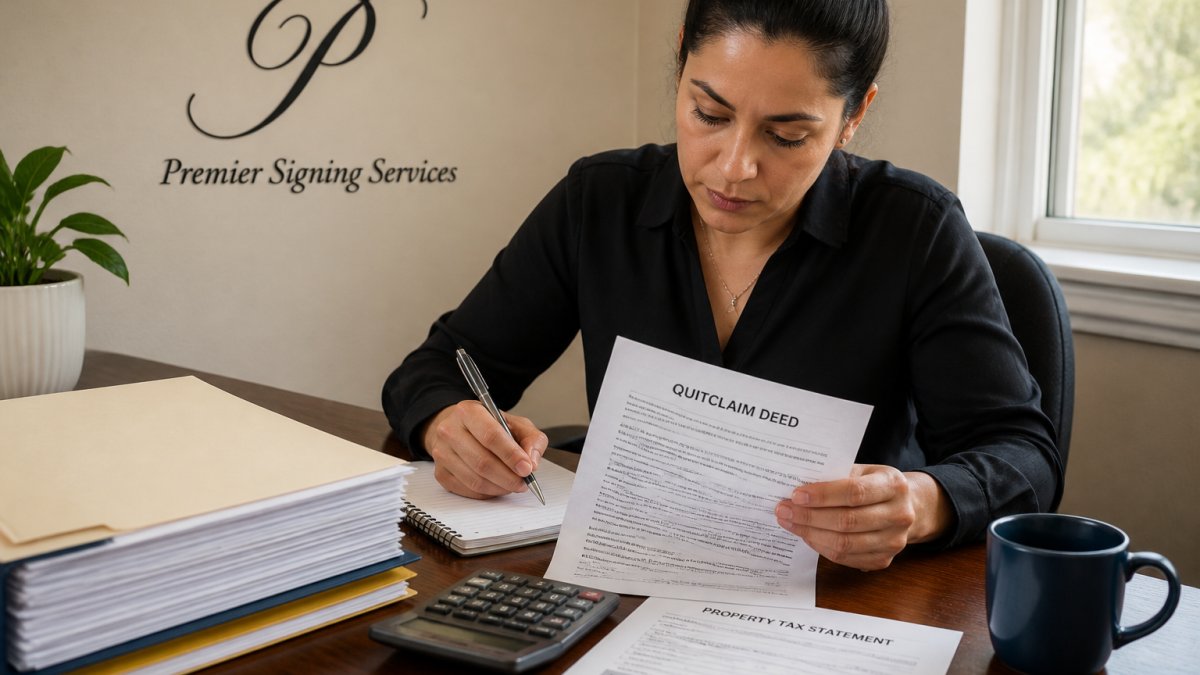
Work through this checklist before you sign or record anything.
- Confirm the property's current fair market value.
- Check your state and county transfer tax rate and any family exemptions.
- Ask the county recorder for the current recording fee.
A rejected deed means a second recording fee and lost time, often from a form signed or notarized incorrectly.
Conclusion
Quitclaim deed taxes are rarely one bill. They are a mix of transfer tax, capital gains, gift tax, and property reassessment, each landing on a different person. Getting the paperwork right the first time saves money and stress.
That is where Premier Multiservices comes in. We offer in-office notary and document authentication, bilingual support in English and Spanish, and hands-on help with property transfers and deeds, guiding you through state requirements so your documents are signed, notarized, and filed correctly.
Frequently Asked Questions
Does a quitclaim deed count as a sale for tax purposes?
Only if something of value changes hands. If you sign a quitclaim deed as a gift and receive nothing in return, the IRS treats it as a gift, not a sale. If you receive cash, property, or debt relief in exchange, it is a sale for tax purposes, and capital gains tax may apply to the difference between your tax basis and the fair market value of what you received.
Who pays transfer taxes when property is transferred by quitclaim deed?
It depends on state law and the county recorder's rules. Some states put the transfer tax on the grantor, others on the grantee, and some let the parties decide in the deed. Many counties also charge a recording fee to file the deed. Check your county recorder's office for the exact split before you sign.
Can a quitclaim deed affect capital gains taxes?
Yes, mainly for the recipient. When you receive property by quitclaim deed as a gift, you usually take the grantor's carryover basis, so a later sale can produce a larger taxable gain. If you inherit the property instead, the basis typically steps up to fair market value at the date of death, which can reduce capital gains tax on a later sale.
Does the person receiving a quitclaim deed owe gift tax?
No. The gift tax, when it applies, falls on the grantor who gives the property away, not the recipient. Most transfers between family members fall under the annual and lifetime federal gift tax exclusions, so no tax is owed, but the grantor may still need to file a gift tax return if the value exceeds the annual exclusion amount.