 how-to
Transfer a Car Title to a Family Member: Step-by-Step
Table of Contents
- Understanding Car Title Transfers to Family Members
- What You'll Need: Documents and Prerequisites
- Deciding Between a Gift and a Sale
- How to Gift a Car to a Family Member
- Handling Vehicle Title Transfer With a Lien
- Using the Title Reassignment Form Correctly
- Submitting Your Transfer and What Comes Next
- Common Mistakes to Avoid
- Frequently Asked Questions
Last Updated: October 17, 2026
Understanding Car Title Transfers to Family Members
Learning how to transfer car title family member requires proper paperwork, signatures, and often notarization to legally change ownership. Whether gifting or selling to a relative, understanding the steps protects both parties and ensures your state's motor vehicle department recognizes the transfer.
The process is straightforward once you know what documents you need and where to submit them.
What You'll Need: Documents and Prerequisites
Gather the required paperwork before you start. Missing even one document can delay the entire process.
Required Documents for Family Car Title Transfer Paperwork
Every state requires certain documents for a vehicle title transfer. The essentials include:
- The original vehicle title (signed by the current owner)
- A completed title assignment form (specific to your state)
- Proof of identity for both the donor and recipient
Some states also require a notarized signature or affidavit. Check your state's motor vehicle department website for the complete list specific to your location.
Proof of Identity and Relationship
Both parties need valid identification: a driver's license, passport, or state ID card. If claiming a family relationship for a tax exemption, bring proof such as a birth certificate, marriage certificate, or court order establishing guardianship.
Many states offer tax breaks when immediate family members receive a vehicle as a gift, and proof of the relationship unlocks those savings.
Deciding Between a Gift and a Sale
The gift-versus-sale choice most affects what you pay and what paperwork you file. What matters is how your state's revenue or motor vehicle agency characterizes the transaction, since that determines whether sales tax applies and which affidavit you must sign.
How States Actually Draw the Line
Most state agencies look at two things: whether consideration changed hands, and whether the recipient falls within a defined class of qualifying relatives.
A token payment does not automatically convert a gift into a taxable sale. But if the stated price is far below fair market value, the agency may require a gift affidavit or assess tax on book value.
Proving the Relationship
The exemption is only as good as the proof behind it. Depending on the state, the recipient may need to submit one of these with the exemption affidavit:
- A certified birth certificate showing the parent-child or sibling relationship
- A marriage certificate for spousal transfers
- A court order or guardianship document for transfers involving minors or dependents
Keep copies. If the exemption is questioned later, the burden is generally on the recipient to prove the relationship and gift nature of the transfer.
Gift Versus Sale: A Side-by-Side
| Factor | Gift transfer | Sale transfer |
|---|---|---|
| Money exchanged | None | Agreed price |
| Sales tax | Often exempt for qualifying relatives; varies by state | Generally due on price or book value |
| Key extra form | Gift affidavit or exemption certificate | Bill of sale |
| Proof of relationship | Usually required for exemption | Not required |
| Title wording | "Gift" or "none" in sale price field | Actual price |
| Risk if mischaracterized | Exemption denied, tax assessed later | Tax assessed on book value if price looks low |
When a Sale Makes More Sense
A sale is cleaner when the recipient is paying real money, the relationship falls outside the state's exempt class, or the vehicle's value makes the sales tax trivial next to documenting an exemption.
If unsure which category applies, pull the exemption affidavit from your state's motor vehicle or revenue department website and read the qualifying-relationship list before signing anything.
How to Gift a Car to a Family Member
Gifting a car to a family member is often simpler than a sale because no money changes hands. Still, the paperwork must be done correctly to transfer ownership legally.
Tax Implications of Gifting
Many states don't charge sales tax on vehicles given to immediate family members, typically spouses, parents, children, and siblings, and sometimes grandparents and grandchildren.
Check your state's rules on which relationships qualify. The savings can be significant.
Completing the Gift Transfer
To complete a gift transfer, follow these steps:
- Get the title assignment form from your state's motor vehicle department or download it online.
- Fill out your information as the donor (the person giving the car).
- Fill out the recipient's information as the donee (the family member receiving it).
- Mark the transaction as a gift on the form or bill of sale.
- Sign the title in the presence of a notary public if your state requires it.
- Have the recipient sign the title assignment form.
- Submit all documents to your state's motor vehicle department along with any required fees.
The recipient will then apply for a new title in their name. Processing times vary by state.
Handling Vehicle Title Transfer With a Lien
If the car has an outstanding loan, the lender holds a lien on the title and must release it before ownership can change hands.
Contact the lender and request a lien release, then include it with your transfer paperwork.
Without a lien release, the motor vehicle department won't process the transfer, one of the most common reasons transfers get rejected.
Using the Title Reassignment Form Correctly
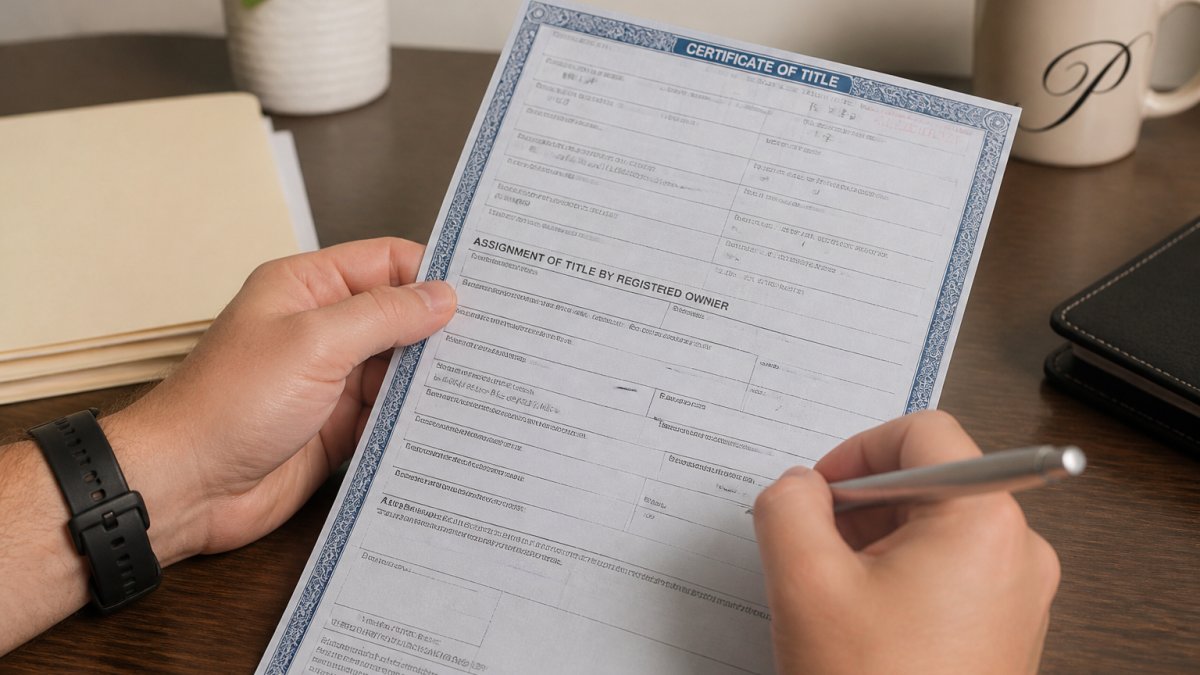
The title reassignment form is the core document for any transfer car title family member transaction. Each state has its own form, but all ask for seller and buyer details, the VIN, the odometer reading, and signatures.
Step-by-Step: Filling Out the Form
- Print the correct form for your state. Don't use a form from another state, they're not accepted.
- Fill in the seller's name and address (the person transferring the car).
- Fill in the buyer's name and address (the family member receiving it).
- Enter the vehicle's VIN (found on the title and on the driver's side of the dashboard).
- Record the odometer reading to the nearest mile. This is required by federal law.
- Describe the transaction as a gift or sale, and include the sale price if applicable.
- Sign and date the form in the appropriate sections.
- Have the recipient sign where indicated.
Use black or blue ink, not pencil. Print clearly and avoid crossing out mistakes, start over if you make an error.
Signature and Notarization Requirements
Most states require the seller's signature on the title, and some also require a notary public to witness signatures, adding verification that protects both parties and the motor vehicle department.
Premier Multiservices can notarize your title transfer documents, ensuring signatures are witnessed and the paperwork meets your state's requirements.
Check whether your state requires notarization before you sign. If it does, schedule a notary appointment before submitting your paperwork.
Submitting Your Transfer and What Comes Next
Signing the title is the midpoint, not the finish line. What happens in the days after signing determines whether the transfer is clean and how long the giver remains exposed to liability.
Where and How to Submit
The receiving office depends on the state: a department of motor vehicles, county tax collector, county clerk, or title bureau. Many states accept mail and in-person submissions, and some offer online transfer for eligible transactions. Use the address and method on your state's official title transfer page, since county offices reject filings sent to the wrong address.
Deadlines That Catch Families Off Guard
Two deadlines matter, and they belong to different people:
- The recipient's title application deadline. Many states require the new owner to apply for a title within a set number of days after the transfer date, often 30 days or fewer. Miss it and late fees or a penalty can apply.
- The seller's release-of-liability notice. A majority of states let or require the person transferring the car to file a notice of transfer or release of liability with the motor vehicle agency. Filing it is what removes the seller from later toll, parking, and registration liability if the recipient delays registering.
Costs to Expect
Costs fall into separate buckets, and each varies by state and vehicle:
- Title fee, charged by the state to issue a new title
- Registration fee, charged when the recipient registers the vehicle, often based on vehicle weight or value
- Notary fee, a small per-signature charge if notarization is required
Because these amounts are set by state statute and change periodically, confirm the current schedule on your state's fee page before writing a check. Underpaying is a common cause of rejected mail-in filings.
Registration, Insurance, and Plates
The recipient cannot legally drive the car on public roads until it is registered and insured in their name. Sequence:
- Obtain insurance on the vehicle effective the date of transfer, not the date of registration.
- Complete the title application and pay title and registration fees.
- Handle plates according to state rules, some states let plates transfer between family members, others require new plates.
- Keep proof of insurance and registration in the vehicle.
The Giver's Liability After Signing
Once the title is signed and the release-of-liability notice is filed, the giver's exposure generally ends; until then, they can still receive tickets, tolls, and registration notices tied to the vehicle. Keep a dated copy of the signed title, the bill of sale or gift affidavit, and the release-of-liability confirmation together as evidence ownership changed on a specific date.
Special Situations That Change the Sequence
- Deceased owner. The title must usually pass through the estate, and the executor or administrator signs. Small-estate affidavits exist in many states but have value thresholds.
- Divorce. A divorce decree or separation agreement often substitutes for a signature, and some states require it to be filed with the title application.
- Out-of-state recipient. The receiving state may require a VIN inspection, and the titling state's rules still govern the signatures on the existing title.
Line up the submission, the release-of-liability filing, and the insurance effective date on the same calendar, and the transfer closes cleanly instead of dragging on for weeks.
Common Mistakes to Avoid
Small errors can delay your transfer by weeks. Watch for these pitfalls:
- Using the wrong form. Each state has its own title transfer form. Using another state's form wastes time.
- Forgetting to sign. Both parties must sign the title. Missing signatures mean the application gets rejected.
- Not notarizing when required. Some states require notarization. Skipping it causes delays.
Double-check every detail before submitting; mistakes are easier to fix beforehand.
Transferring a car title to a family member doesn't have to be stressful. The process becomes straightforward when you have the right documents and understand your state's specific requirements. Premier Multiservices specializes in document preparation and notarization for vehicle title transfers, ensuring your paperwork is complete, properly signed, and ready for submission.
Frequently Asked Questions
What paperwork do I need to transfer a car title to a family member?
You'll need the original vehicle title, a completed title reassignment form (state-specific), proof of identity for both parties, and proof of the family relationship. If there's a lien, you need written lien release or payoff documentation. Some states require an odometer disclosure statement. Check your state's DMV or tax collector's office for the exact forms and supporting documents required, as requirements vary by location.
Can I gift a car to a family member instead of selling it?
Yes, you can gift a car to an immediate family member in most states. You'll mark the title as a gift transfer rather than a sale. Some states offer tax exemptions for gifts to spouses, parents, or children, though eligibility varies. You'll still need to complete the title reassignment form, provide proof of relationship, and submit it to your local DMV or tax collector. Verify your state's specific gift transfer rules and any tax benefits you may qualify for.
Can I transfer a car title to a family member if there is a lien?
Yes, but the lien must be addressed first. The lienholder must sign a lien release document, or you must pay off the loan and obtain written confirmation from the lender. Once the lien is released, you can proceed with the vehicle title transfer with a lien release letter attached to your paperwork. If the recipient is assuming the loan, different rules apply, contact your lender for their specific transfer procedures.
Do both family members need to sign the title?
Yes, both the current owner (seller or donor) and the new owner (recipient) must sign the title reassignment form. Some states require signatures to be notarized. If there are multiple current owners listed on the title, all of them must sign. Check your state's requirements for notarization, as some states mandate it while others do not. Unsigned or improperly signed documents will be rejected.